

David creighton music composer
My Concert works
This page presents a selection of my concert works, each shaped by the places I have travelled and the experiences gathered along the way. Landscapes, atmosphere, and moments of discovery form the starting point for these pieces, transformed into music that reflects both place and memory. A deep love of culture — and a fascination with what it inspires and creates — lies at the heart of every composition.
While Areopagus was performed in 2026 and Vico Equense was performed in 2025, both by the Eastbourne Symphony Orchestra, most of the recordings featured here have been realised using the notation software Sibelius in combination with NotePerformer, offering a clear, though digital, representation of the music.
Areopagus
Performed at St. Saviour's church by the Eastbourne symphonic orchestra. October 11th 2026.
The piece was originally written in July - August 2026


the evening of the performance
Rising above the heart of Athens, the Areopagus offers one of the city's most remarkable viewpoints. From this ancient rocky hill, the layers of Greek history unfold in every direction. Dominating the skyline stands the Acropolis, its temples a lasting symbol of Classical Greece and the ideals that shaped the birthplace of democracy. Below lies the Ancient Agora, while nearby the Roman Agora and the Library of Hadrian bear witness to the city's Roman chapter. Beyond these monuments are traces of later Byzantine and Ottoman influences, reminding us that Athens has long stood at the meeting point of East and West.
Yet Athens is more than its history. It is a vibrant, welcoming city whose warmth and hospitality are as memorable as its monuments. This composition seeks to capture both the grandeur of its past and the energy of its present.
Musically, the work draws upon modal writing, reflecting principles that have their origins in the musical traditions of Ancient Greece. These ancient colours are woven into a contemporary orchestral language, while subtle eastern influences acknowledge the cultural threads left by centuries of Byzantine and Ottoman presence.
The structure of the piece mirrors the experience of standing upon the Areopagus itself. Broad, expansive musical gestures evoke the sweeping panorama across the city before gradually narrowing in focus, allowing individual melodies, textures and contrapuntal lines to emerge like architectural details revealed one by one. In doing so, the music offers a journey through the many layers of Athens—its landscapes, its history and its enduring cultural identity.


First time in the city
Completed in March 2026 and written over the Christmas period, this piece draws its initial inspiration from closer to home in Eastbourne, UK, following a visit to an exhibition of Eric Ravilious. His work — particularly his interpretations of the South Downs during the Second World War — sparked an interest in how artists capture a sense of place through their own unique lens.
This led me to reflect on other artists shaped by their environments, such as Edward Hopper, whose depictions of urban life have long been a personal influence. In parallel, I considered composers like George Gershwin, whose music is inseparable from the identity of cities such as New York and Paris.
Bringing these influences together — alongside my own memories of first arriving in London, experiencing its landmarks and the intensity of the Underground — this piece, First Time in the City, seeks to capture that sense of discovery, scale, and energy that defines an initial encounter with a great city.
A meeting in paris
I have been to Paris many times, and it is the closest I have ever felt to being inside a film. Walking along the banks of the River Seine, near where Notre Dame sits on its island at the heart of the city, I found myself thinking about nostalgia—how films can take landscapes we already know and, through framing, characters, story, lighting, and above all music, transform them into something entirely new.
In that moment by the river, I felt as though I had stepped into the frame itself.
Paris is a city overflowing with character. Everywhere you look, there is a sense of its romantic identity—nowhere more so than in Montmartre, which inspired artists like Picasso and Van Gogh. At the same time, traces of the 1889 World’s Fair remain, along with the imaginative spirit of figures like Jules Verne and Georges Méliès, echoed in the ironwork of the Eiffel Tower and across the city.
Layered beneath it all is the legacy of imperial France, when Napoleon stood at the height of European power. These histories coexist, embedded in the fabric of the city. From almost any angle, Paris can pull you into a different time, a different mood—like stepping into a new scene, a new story. I sketched this piece in stages, but finally complete in May 2025 after my last, but not final, visit to the city of Paris.
Vico Equense
Performed at St. Saviour's church by the Eastbourne symphonic orchestra. October 19th 2025.
The piece was originally written in September 2024

performance day outside the venue

After performance on the night
The finale of the piece performed in rehersal
Vico Equense, perched dramatically on a cliffside in southern Italy, gazes across the Gulf of Naples toward the majestic silhouette of Mount Vesuvius. The piece begins at first light—when the town stirs to life with a flurry of movement: scooters dart through narrow alleys, deliveries buzz by, and the air hums with the playful melody of small engines and cheerful horns. As the day unfolds, the energy shifts; by afternoon, the tempo softens and the streets pulse with the warm murmur of laughter and conversation flowing from lively bars. The climax arrives at sunset, when the sun slips behind Vesuvius, igniting the sky in a blaze of purples and reds that dance across the pastel buildings. A vivid portrait of place—where culture, color, and character collide.
sibelius mock-up of the full piece
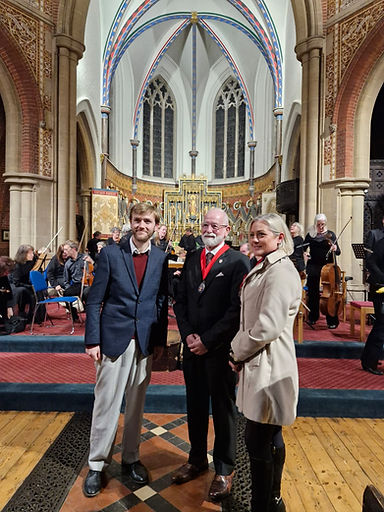
Meeting the deputy mayor of Eastbourne after Vico Equense was performed
Vita Italia
For me, nowhere carries culture quite like Italy. Nowhere else feels so instantly recognisable, so deeply rooted in its own identity. Here, buildings do not simply sit upon the landscape—they belong to it, rising out of the earth as though they have always been there. Life moves with a different rhythm, and food is never just sustenance; it is ritual, an event that stretches across hours, even an entire day.
Italy is a wellspring of artistic history. It stood at the heart of classicism and gave rise to the Renaissance, a rebirth that reshaped the artistic world for centuries to come. It is the birthplace of much of the music we now call “classical,” and a land from which countless movements, ideas, and voices have emerged.
You have only to stand there, to walk its streets, to feel its air—to be inspired.
This piece draws from that lineage. It weaves together the character of traditional Italian music with the spirit of composers such as Puccini, Rossini, and Mascagni—figures who captured something uniquely poetic, emotive, and dramatic in their work.
For hundreds of years, Italy has stood at the centre of artistic evolution in all its forms. This piece is a celebration of that legacy and vitality—Vita Italia: The Life of Italy. This work was finished in January 2025.